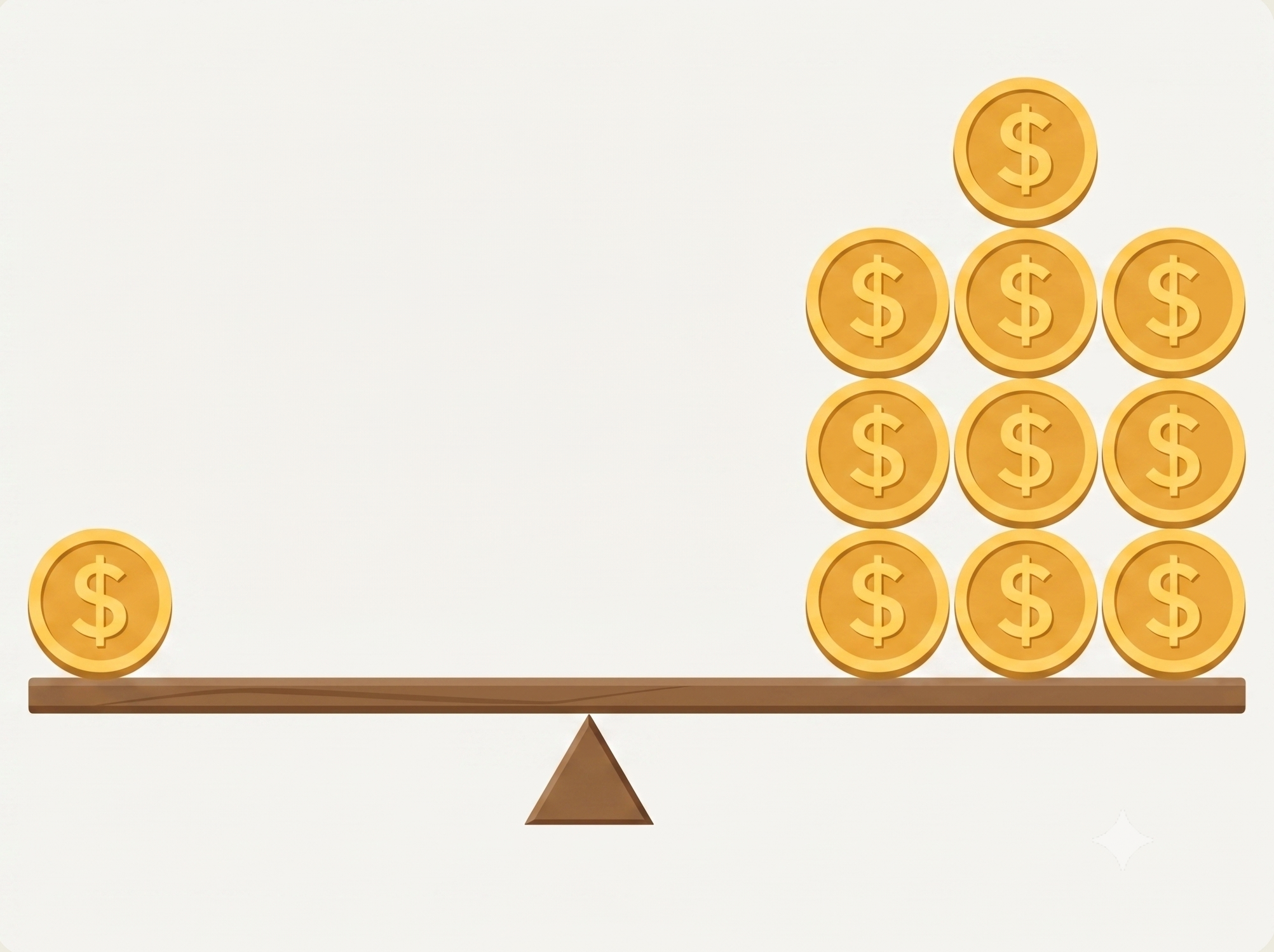
“When I first started forex trading, I was actually making money.”
“I was maintaining a 70% to 80% win rate, but one day my account blew up in an instant.”
In reality, it is said that nearly 60% of participants in the forex market experience temporary profits and a “winning phase.”
Despite this, only a mere 10% manage to survive in the market for 1 to 3 years and steadily grow their total assets.
Why does this bizarre phenomenon occur?
The reason lies in a dangerously naive definition of “winning” and the optical illusion of the “win rate” metric that traps so many people.
In this article, we will break down the mechanics of Win Rate, Risk/Reward, and Expected Value using concrete numbers, and help you install the “Casino House (Edge)” mindset utilized by the top 10% of winning traders.
The Trap of the Easy “60% to 80% Win Rate”
Why can even complete beginners temporarily achieve a win rate of over 60%?
The reason is brutally simple. The market is a 50/50 game (it either goes up or down), and if you close your position while in profit by even a single dollar, it counts as exactly “one win.”
- Example: A few minutes after buying, the moment you see an unrealized profit of +$2.00, you hit the close button.
With just that, “1 Win” is recorded in your trading history.
When you are losing, you postpone taking the loss, thinking, “It will come back eventually.” If you only collect the moments when the price turns slightly positive, anyone can easily play the role of a “genius trader with a 70% to 80% win rate.”
However, there is a fatal trap here.
While your winning profits are kept tiny at +$2.00 or +$5.00, when you lose, you endure the pain until you are forced to take a massive loss of -$100.00.
No matter how many times you win, a single loss will blow away all of your accumulated profits. This is the reality of the “Make Small, Lose Big” cycle, explaining why 60% of people experience winning, yet only 10% survive.
Ad Space 1
The Truth of “Win Rate” and “Risk/Reward” in Numbers
What determines trading success is not the isolated number of your win rate.
It is the multiplication of “Win Rate” × “Risk/Reward (Profit/Loss Ratio).”
- Risk/Reward (Profit/Loss Ratio): The ratio of the “loss amount” to the “win amount” in a single trade.(Example: If you lose $10 and win $30, your Risk/Reward is 1:3)
Let’s look at two traders with completely opposite styles.
Trader A (The Typical “High Win Rate / Make Small, Lose Big” Trader)
- Win Rate: 80% (8 wins, 2 losses out of 10 trades)
- Average Win: +$10.00
- Average Loss: -$100.00
- Risk/Reward: 10:1 (Extremely poor: risking 10 to make 1)
[Total P/L After 10 Trades]
- Wins: +$10.00 × 8 = +$80.00
- Losses: -$100.00 × 2 = -$200.00
- Final Balance: -$120.00 (Loss)
Trader B (The Typical “Low Win Rate / Make Big, Lose Small” Trader)
- Win Rate: 40% (4 wins, 6 losses out of 10 trades)
- Average Win: +$30.00
- Average Loss: -$10.00
- Risk/Reward: 1:3 (Excellent: risking 1 to make 3)
[Total P/L After 10 Trades]
- Wins: +$30.00 × 4 = +$120.00
- Losses: -$10.00 × 6 = -$60.00
- Final Balance: +$60.00 (Profit)
Trader A, who boasts an 80% win rate, is seeing their account capital steadily depleted. Meanwhile, Trader B, whose win rate doesn’t even reach 50%, is steadily growing their funds.
Looking at these numbers, it should be obvious how dangerous the intuition that “a high win rate means a superior strategy” truly is.
Ad Space 2
The True Nature of “Expected Value” and “Edge”
So, how can you shift to the 10% side that survives and profits in total?
This is where the concept of “Expected Value” becomes essential.
For example, if your Risk/Reward is exactly 1:1 (you win +$10.00 and lose -$10.00), you absolutely need a win rate of over 50% to make a total profit.
But look at Trader B again.
- Win Rate: 40% (Losing more than half the time)
- Risk/Reward: 1:3 (Winning 3 for every 1 lost)
If you only look at the win rate, it’s “a mere 40%.” However, because the Risk/Reward is an excellent “1:3”, executing 10 trades results in a total plus of +$60.00.
This state, where the combination of “Win Rate × Risk/Reward” leaves your total balance in the positive, is what we call having a “Positive Expected Value” or an “Edge.”
It doesn’t matter if your win rate is high or low. As long as you have built a formula (this mathematical combination) that leaves positive capital in your account, there is absolutely zero need to get emotional over every single win or loss.
Learn from “The Casino House”
In Roulette or Blackjack, the casino’s (The House) win rate is only around 51% to 53%.
Players sometimes go on winning streaks, and the casino might lose a large sum of money in a single night.
However, casino managers never panic.
Why? Because they know that if the game is repeated thousands of times, that tiny difference in win rate creates an “Edge that guarantees a total profit.”
The 1% to 10% of humans who survive this brutal market are not gamblers getting wildly excited over a single win or loss. Just like the Casino House, they are simply, mechanically repeating trades that have a positive Expected Value (Win Rate × Risk/Reward).
Ad Space 3
Practical Steps to Shift to “Probability Thinking”
Here are the concrete steps to eliminate emotion and make “Expected Value” your ally.
- Do Not Let One Trade Sway Your Emotions: Today’s one win or one loss has absolutely zero value. It is merely the “1st try” out of 100 trades you will take. Stop doubting your talent or your strategy based on a single outcome immediately.
- Grasp Your Strategy’s “Win Rate × Risk/Reward”: Through backtesting and verification, confirm if your strategy forms a combination that yields a positive total. Strictly adhere only to rules that have a positive expected value.
- Accept Statistical Variance (Drawdowns) as Normal: If you flip a coin 10 times, you might get “tails” 5 times in a row. Similarly, even with a highly superior strategy, a 5-trade losing streak happens purely due to probability. Do not equate “losing streak” with “broken strategy.” Treat it simply as “statistical variance” and utilize a rigid money management system (e.g., keeping single losses under 2% of total capital) to endure it.
Summary
- Do not be fooled by temporary wins (a 60% win rate). What truly matters is the Expected Value determined by “Win Rate × Risk/Reward.”
- Even with a high win rate, “Make Small, Lose Big” will bankrupt your account. Even with a low win rate, “Make Big, Lose Small” will grow your assets.
- Ditch the gambler’s mindset of obsessing over a single outcome. Just like the Casino House, mechanically repeat “trials with a positive expected value” 100 times.
The market is a game where only those who understand mathematical edges and probabilities, and who can execute them calmly and mechanically, survive until the very end.
Ad Space 4
Comments